

Forecast Environmental Risk Before It Becomes Operational Disruption.
Artemis-era missions move crews farther from Earth, shrink response windows, and increase the cost of late or uncertain space weather decisions. HelioShield does not replace NASA science or solve missing-sensor gaps — it helps mission teams use today’s data earlier and more consistently.
An Operationalization Layer — Not a Replacement for NASA Science.
NASA already produces world-class heliophysics. Mission operators already make crew-protection decisions in real time. The gap HelioShield closes is the one in between: turning research-grade signals into calibrated, repeatable, decision-ready outputs that fit mission tempo and threshold logic.
HelioShield Is
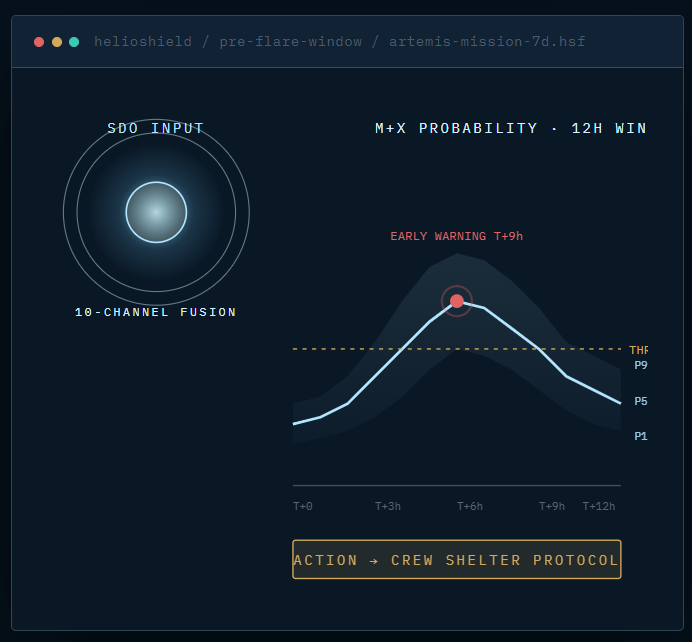
A bounded operationalization layer that pulls signal upstream from solar imagery, fuses multi-wavelength sources, and outputs uncertainty-aware forecasts calibrated to operational thresholds.
HelioShield Is Not
A replacement for NASA science assets, off-Sun sentinels, coronal magnetic-field measurements, or the agency’s existing crew-protection decision authority. It complements observations; it does not pretend to provide them.
NASA’s Pain Points Map to Three Gaps HelioShield Can Address.
Artemis crews operate beyond Earth’s protective magnetic field. NASA and NOAA already translate space weather conditions into real-time crew-protection decisions. HelioShield works inside that workflow — earlier in the timeline, on rarer events, with calibrated uncertainty.
L1 Gives Minutes, Not Hours.
HelioShield pulls signal upstream from solar imagery before the in-situ decision window closes. The goal is earlier indication of potentially consequential solar activity — before the event unfolds at L1 — extending the time available to plan, position, or shelter.
Mission Risk Sits in M/X Events.
Mission-relevant risk lives in the rare tail. HelioShield is optimized for M+X relevance, multi-wavelength fusion, and uncertainty bands rather than mean-case skill. Operators get decision-ready percentile outputs, not just point predictions.
Calibrated Thresholds, Not Papers.
NASA has science assets; operators need calibrated thresholds, lead-time skill, and repeatable decision-ready outputs. HelioShield is the R2O bridge — translating benchmark-grade research into outputs that fit mission tempo, audit trails, and threshold logic.
What HelioShield Does Today.
Performance against held-out archival data, with quantile uncertainty already implemented and a public-data pipeline running end-to-end.
Transformer pre-flare forecaster on held-out archival data. Optimized for rare-event recall, the metric mission operators actually need.
Top CaiT (class-attention image transformer) classifier result on 10-channel SDO imagery. Multi-wavelength fusion, not single-channel skill.
Quantile outputs already implemented for threshold-based decisions. Operators get bands, not just point estimates.
Integrated pipeline: 9,222 samples × 198 engineered features. Reproducible from public sources end-to-end.
Honest Bounds — Still Unproven
Skill vs. climatology and persistence baselines, false-alarm ratio by lead time, real-time inference at operational tempo, and downstream geomagnetic validation remain open work. HelioShield is presented as a credible operationalization layer in development — not a finished operational system. The path from these archival-data results to a NASA pilot is the conversation we want to have.
An Upstream Warning Layer for Artemis-Era Operations.
From pre-flare prediction to calibrated mission outputs — the value sits in improving the warning layer first, then expanding into downstream consequence modeling.
- Lead-Time Improvement measured against accepted baselines — climatology, persistence, and current operational forecasts.
- Rare-Event Recall on trusted, agency-curated event sets, not on cherry-picked test windows.
- UQ Calibration on workflow thresholds operators already use, so percentile outputs map cleanly to existing decision logic.
- Mission-Aligned Outputs sized to crew-protection windows, EVA planning cycles, and Artemis-era operational tempo.
- Audit Trail for every prediction — provenance, model version, input data window, confidence band, and threshold trigger.
Today, Conditional, and Roadmap.
HelioShield is honest about what works now versus what’s a future integration. Operational value comes from improving the warning layer first.
Pre-Flare Warning Layer
Live · In Development
SDO multi-wavelength imagery → transformer pre-flare forecaster → quantile uncertainty outputs → threshold-aligned alerts. Operating end-to-end on archival data; real-time inference is the next milestone.
NVIDIA Earth-2 / PhysicsNeMo Coupling
Conditional · Roadmap
Pair HelioShield with Earth-2 / PhysicsNeMo-class terrestrial models as a downstream consequence layer for atmosphere-density, drag, and environment-aware mission planning. Subject to access and integration scope.
Geomagnetic Validation Extension
Roadmap
Downstream geomagnetic validation — connecting solar pre-flare prediction to ground-side and near-Earth impact. Planned post-pilot once the warning layer demonstrates lead-time skill against operational baselines.
Structured for Public Sector Deployment.
HelioShield is structured for public sector procurement. Deployment maps to the Aperio Capability Pilot → Operational → Enterprise package set, with HelioShield-specific activation, forecast, and sustainment packs.
HelioShield Acquisition Path
- Capability Pilot60–90 Days
- Operational Deployment6–12 Months
- Enterprise PlatformMulti-Year
- Activation PackRequired
- Processing & Forecast PackScope-Based
- Sustainment PackRecurring
- Request a QuoteContact Us
Ready to Close the Decision Gap?
Aperio’s HelioShield team will walk through the current performance envelope, the three gaps it addresses, the honest bounds of what’s still unproven, and the right pilot scope for your mission environment.